Start with practical preferences
You can describe a preference without sharing a diagnosis or medical history. Useful details might be a step-free entrance, a seat with a backrest, a quieter corner, a shorter walking distance or a planned break. Explain the practical requirement and ask whether the proposed setting can accommodate it.
This website describes social companionship. It does not offer personal care, medical supervision, mobility assistance or specialist support. If your outing requires those services, arrange appropriate assistance separately. Do not assume that a social companion can provide a service simply because a venue is described as accessible.
Check the entrance and the route inside
Contact the actual venue about the entrance you intend to use. A building may have more than one doorway, and a step-free route may differ from the main approach. Ask about thresholds, ramps, working lifts, the distance to seating and access to toilets where those details matter to your visit.
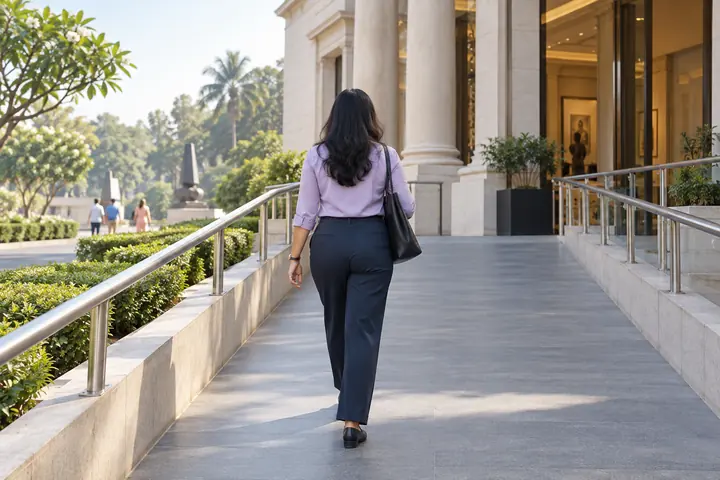
Photographs cannot establish current access conditions. The images on this site are fictional, including the entrance illustrated on this page. The area directory provides geographic context rather than an audited list of accessible businesses. Check facilities directly for your date, particularly where temporary exhibitions or maintenance can change the route.
Match the sound and pace to the occasion
A music performance, a busy food court and a quiet café offer very different sound environments. Discuss what kind of setting feels comfortable before choosing an experience. At a ticketed venue, ask about seating arrangements, intervals, re-entry and any access facilities relevant to you.
For an art and culture outing, one room or exhibition may be enough. You need not cover every floor to have something interesting to discuss. Build in seated pauses and leave room to skip an optional stop. A shorter, manageable visit can be more enjoyable than a schedule built around seeing everything.
Allow for weather and independent travel
Consider the distance between the arrival point and the entrance, exposure to heat or rain and the availability of a sheltered waiting place. Avoid a route that assumes continuous walking if you would prefer a seated meeting. An indoor café can be the whole outing rather than a fallback after an ambitious walk.
Arrange transport that meets your own needs and verify its details with the provider. No accessible transport service or vehicle is provided by this website. Use the planning page to record a simple meeting point, expected duration and alternative if weather makes the original approach unsuitable.
Using the website
The site provides text-based navigation, a skip-to-content link, keyboard-operable controls and pages that adapt to narrow screens. Gallery pictures have descriptions, while decorative graphics are marked separately. Motion is reduced when your browser requests reduced motion. Core guidance and internal links remain readable without JavaScript.
These are implementation features, not a claim of formal accessibility certification. If something prevents you from using a page, note its address, your device and the action that failed. Once real contact details are configured, those details can help the operator reproduce the issue. The current contact page is a demo draft tool, so it cannot send a report on your behalf.